Night reading
How to read faster on easier pages
Reading faster is mostly practice on easy pages, and the useful skill is knowing which pages should never be hurried at all.
·

If you want to learn how to read faster while keeping what you understand, practise on pages you can follow and build your vocabulary. Slow down and reread when a sentence carries a decision or a difficult idea. A review by Keith Rayner and colleagues found a trade-off between speed and comprehension.
Speed reading is older than the apps
Rayner and colleagues discuss Evelyn Wood's Reading Dynamics programme, introduced in 1959, and apps that display one word at a time in a fixed place.
In their 2016 review, the authors judge it unlikely that a reader who usually reads about 250 words a minute will reach 500 to 750 words a minute while understanding the text as well. Speed reading is an attempt to raise the rate while keeping the same understanding.
The rule here runs the other way: easy pages get faster with practice, and hard pages stay slow on purpose.
Vocabulary and reading speed
Familiar words take less time to recognise. Marc Brysbaert's 2019 review pooled 190 studies and 18,573 participants and estimated adult silent reading averages of 238 words a minute for English non-fiction and 260 for fiction. Most adults reading non-fiction silently in the studies fell between a hundred and seventy-five and three hundred words a minute. Average word length helped explain the gap between the two means.
When a passage hinges on an unfamiliar word, stop to check what the word does in that sentence.
"practice reading and to become a more skilled language user"
Keith Rayner, Elizabeth Schotter, Michael Masson, Mary Potter and Rebecca Treiman, psychologists, writing on reading speed and comprehension in Psychological Science in the Public Interest, May 2016.
Readers search for speed before recall
The saved US export from 27 September 2026 gave an estimate for how to read faster. This was more than ten times the estimate for how to read more. Two longer queries asked for speed together with understanding or recall.
The table shows five phrases in the saved US Ahrefs export of 27 September 2026.
| Query | US searches a month | Keyword difficulty |
|---|---|---|
| how to read faster | 6,400 | 8 |
| how to read more | 600 | 0 |
| read faster | 300 | 36 |
| how to read faster and understand | 250 | 3 |
| how to read faster and retain more | 200 | 0 |
These are estimates from one tool and one country. Keyword difficulty is Ahrefs' score out of a hundred. It estimates the difficulty of ranking on Google's first page. The counts give each question a rough scale.
Pages for a slower read
A reader can go back because a later word changes the meaning of an earlier one. In their 2014 experiment in Psychological Science, Elizabeth Schotter, Randy Tran and Keith Rayner masked words as readers moved past them. Comprehension fell for both ambiguous and unambiguous sentences when readers could no longer go back.
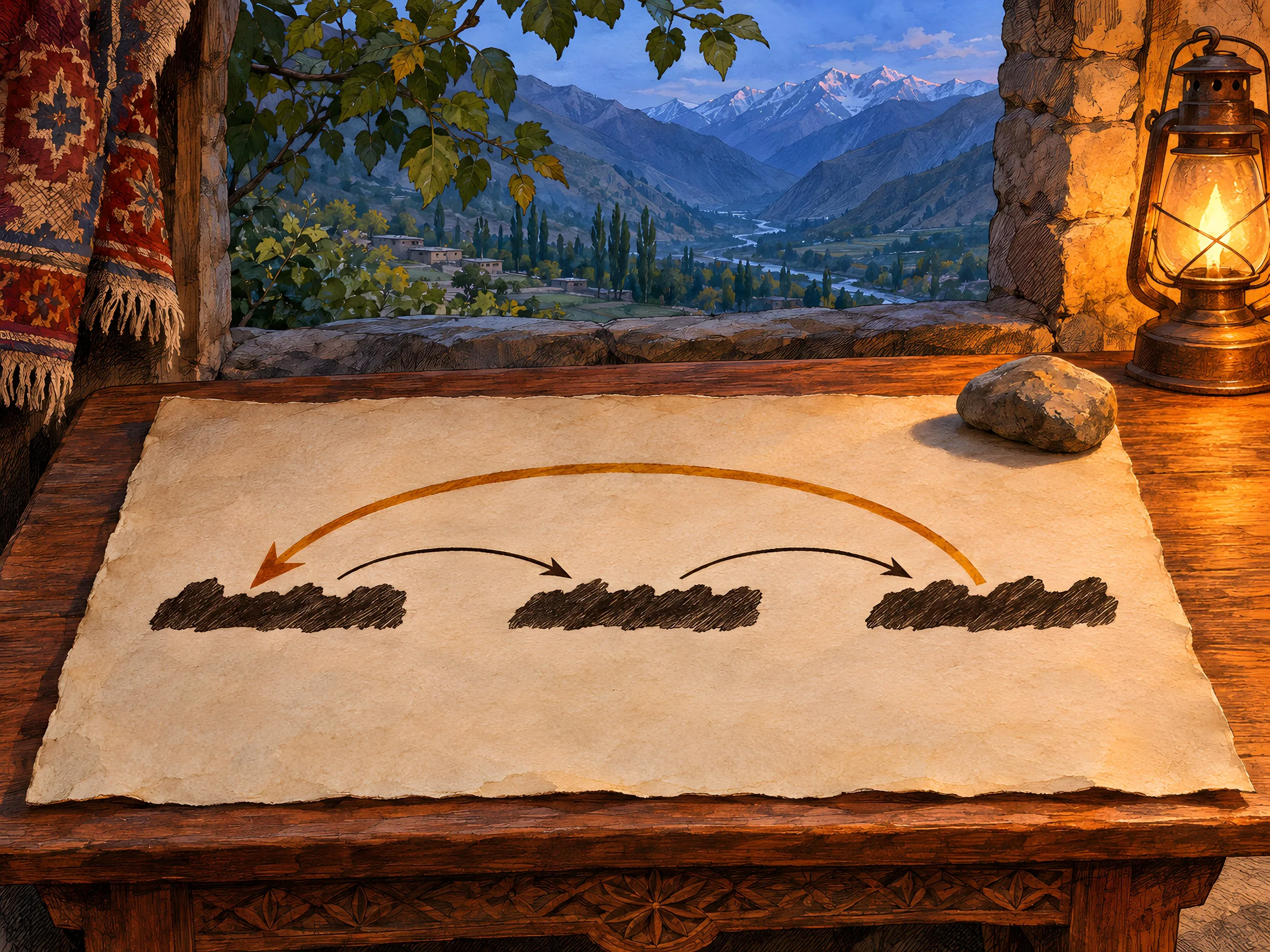
A second look at an earlier word can help the reader make sense of what follows.
Read these slowly: a contract clause you are about to sign, a proof whose next step depends on this one, and a poem in translation. Also read slowly through the first chapter of a difficult book and any page you will have to explain to somebody tomorrow. The first chapter earns its place because it often teaches the vocabulary the rest of the book runs on. The same question of pace runs through The long way round, the essays on work that takes a season.
Skimming, named honestly
Skim when you are deciding whether a text is worth a closer read. Ronald Carver's 1997 paper, Table 1, proposes five rates for college students, from memorising at 138 standard-length words a minute (six characters each, spaces included) and learning at 200 to ordinary reading at 300, skimming at 450 and scanning at 600. He called ordinary reading rauding. There is a limit to what the table tells you. Its scanning rate cannot tell you how quickly a reader can follow a difficult argument.
The Rayner review suggests that skimming can be enough when you want the gist. I use it to decide what needs a second look, then go back to the pages I need to understand.
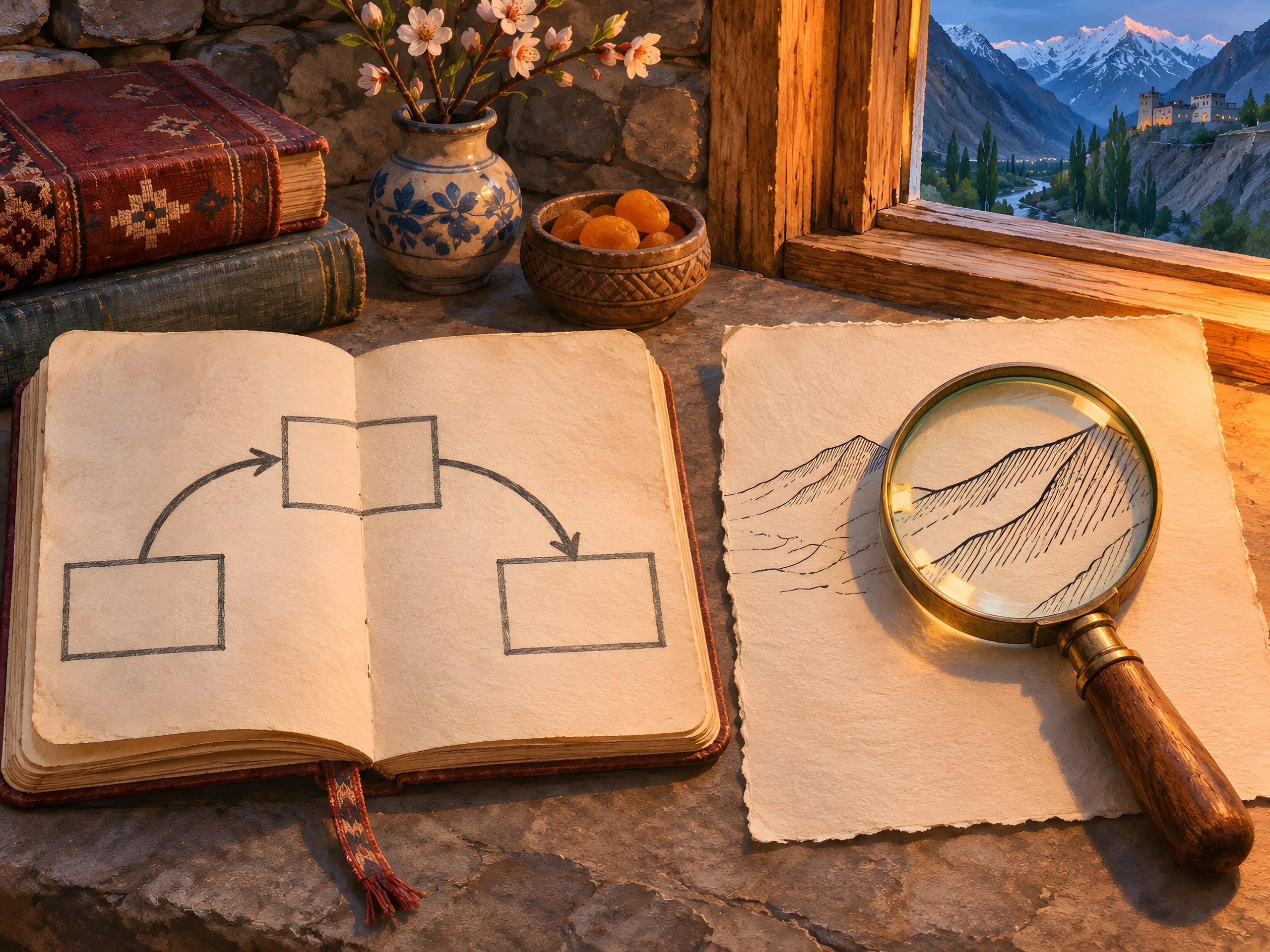
The notebook and close view illustrate the approach: skim for the shape of the argument, then return to the passage you need to understand.
A hard book needs two readings
Build fluency on pages you can follow, such as novels or history written for a general reader. For a hard book, read each chapter twice. The first pass goes straight through without stopping, to learn the shape of the argument and the words it leans on. The second goes with a pencil, and that pass is where the rereads belong.

Read a chapter twice: let the first pass trace the argument and the second settle the hard lines.
Before closing the book, say what the chapter argued in a sentence of your own. The Night reading shelf explains which books I choose and how a chapter becomes a note.
The pool on the cover is where the stream slows. I leave a hard chapter open for much the same reason.