Getting found
Content marketing strategy for ecommerce
A shop's content plan starts from what buyers ask before paying, about cost, delivery, returns and fit, and the catalogue decides the order.
·

A content marketing strategy for ecommerce is a plan for who a shop wants to reach, what buyers need to know and which pages will answer them. Write category and product pages first, with clear answers on delivery, returns and fit. Use buying guides to compare products, then save the blog for questions those pages cannot answer. In the studio's search on 31 October 2026, all six leading domains belonged to hosting, shop-app or content-service vendors.
If you manage a brand with a considered range and fear a store blog will cheapen it, start where buyers stall before paying. The rule: write the pages buyers read before paying first, and write a blog only for the questions those pages cannot hold.
How do I identify my target audience?
Start with existing customers' questions, reviews, return reasons and purchase patterns to identify who needs the products and what stops them buying.
Read your last month of customer emails before planning a single post. If a question keeps coming up, check whether the relevant product or policy page already answers it clearly.
Group needs by product use: a blanket for a sofa, a guest bed or a gift raises different questions. Note who uses it, what they compare and what might stop the purchase. Keep the customer's wording beside each group, so the plan starts from a need rather than an imagined reader.
How do I build an ecommerce content strategy?
Set one business goal, audit existing content, research buyers' questions, choose the right pages and channels, and assign an owner and measure to each task.
Check which existing pages already answer those questions and where the gaps remain. Use keyword research, finding the phrases buyers search for, to check their wording. Match each phrase to search intent: whether someone wants to learn, compare or buy. Choose a page that serves that purpose, then a channel customers already use. Use the catalogue section below to order the work. Record the owner, intended result and review point before commissioning a draft.
What do buyers ask before they pay?
Buyers ask what the order will cost in full, when it will arrive, and what happens if it is wrong. In Baymard Institute’s separate US online shopper survey, after setting aside people who were only browsing, shoppers cited extra costs (40 percent), slow delivery (20 percent), an unsatisfactory returns policy (13 percent) and a total they could not see up front (12 percent).
Show the delivery prices and times, returns terms and sizing on pages buyers can reach before checkout. For a blanket, put its dimensions beside the product photo and link to the return conditions beside the price. Check whether the delivery page explains any charges that depend on where the buyer lives. If the amount depends on the delivery address, show how the shop calculates it and when the buyer will see the total.
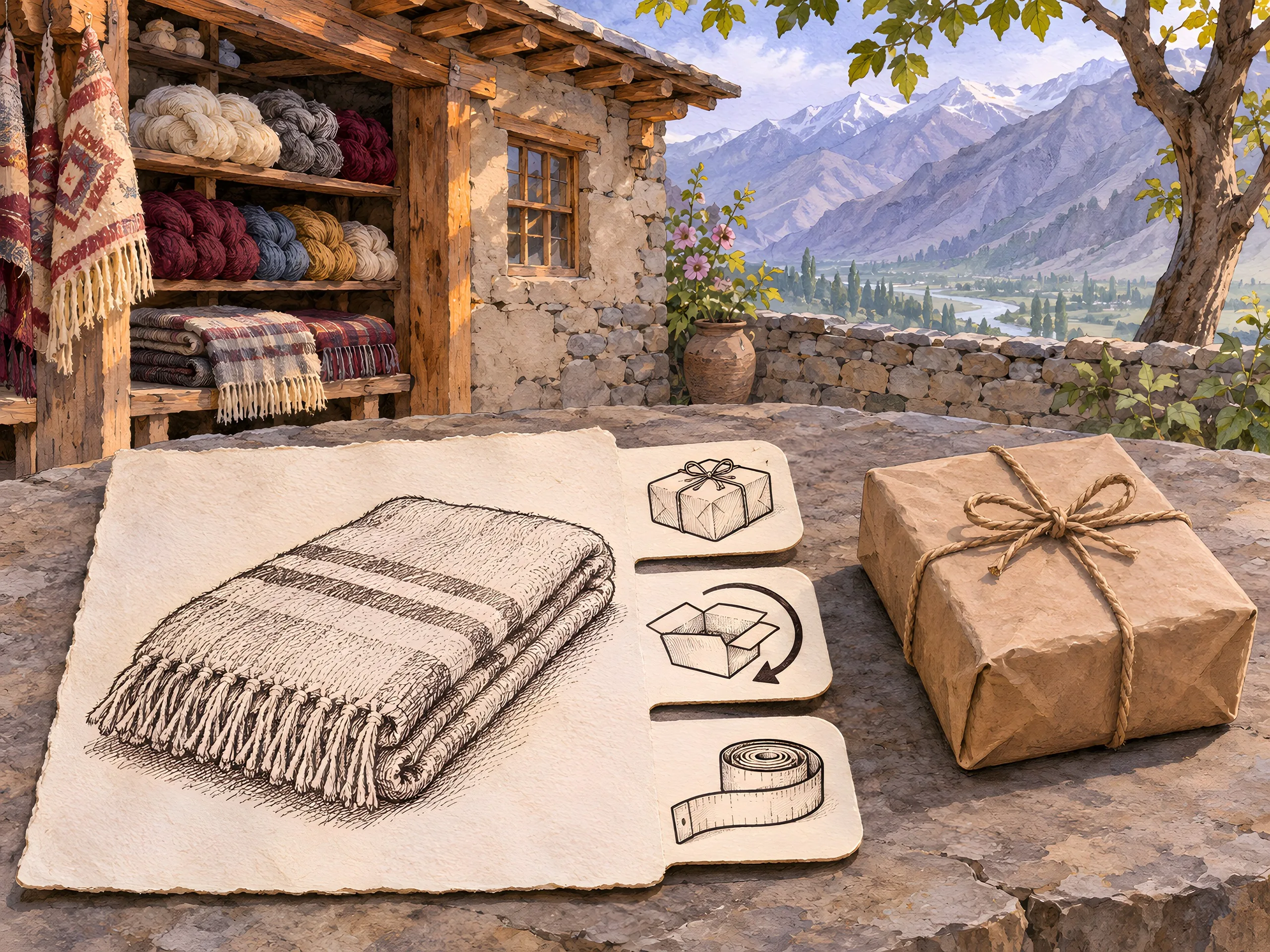
A blanket page with three tabs. Put delivery, returns and size where buyers can check them before paying.
Which pages come before a blog?
Start with category pages that organise the range and product pages that answer buying questions. Google's guide to ecommerce website structure describes how Googlebot, Google's tool for finding pages by following links, discovers products. It warns: "If category pages don't include direct links to all products in a category, Googlebot might not find all of your products by crawling alone."
Write the category pages
Write one page per range. Say what the range holds and whom it suits, and link to every product in it.
Fix the product pages
Give the full price, delivery time, materials and size or fit on every product page, in the shop's own words.
Answer delivery, returns and fit
Write one plain page each for delivery, returns and fit, with the costs and the dates printed. Link to each from every product page.
Write the buying guides
Explain how to choose between the products a buyer compares, with a table and a "best for" column.
Add a blog for the questions left over
Write posts for the questions no product page can hold: gifting, care, how a thing is made.
When to write and revisit each page:
| Page | When to write it | When to revisit it |
|---|---|---|
| Category pages | first, one per range | when the range changes |
| Product pages | with each product | when the price, stock or materials change |
| Delivery, returns, fit | before launch | when a carrier, a policy or a size chart changes |
| Buying guides | after the category pages | once a year, or when a product is replaced |
| Blog | last, from a calendar | when facts change; read its performance after at least sixty days |
Does the catalogue change the plan?
The catalogue decides which pages carry the most weight. For a large catalogue, prioritise category pages and useful filters. For a smaller range, give product details, care instructions and buying guides more space.
Which pages to prioritise by catalogue:
| Catalogue | Lead with | Then | Best for |
|---|---|---|---|
| A large range, many similar products | category pages, filters, comparison tables | buying guides by use | homewares, parts, supplies |
| A small considered range | product pages with full detail, care and fit pages | a buying guide per product line | heritage goods, furniture, fashion |
| A seasonal range | category pages that stay, products that rotate | a guide per season, refreshed | gifts, garden, clothing |
Technical search on a shop covers crawling, how search engines find pages by following links. It also covers the filters and duplicate pages that a large catalogue brings.
What should a buying guide compare?
A buying guide should compare the products a buyer is already choosing between, on the attributes that decide the choice, and say plainly which one suits whom. The usual attributes are price, size or capacity, material, care and delivery time. The table needs a "best for" column, so the guide ends in a recommendation rather than a list.

Two blankets on the same table. Compare their size and weave before choosing one.
A guide that sets the shop's products beside a rival's is a comparison page. It has to name the cases where the rival is the better buy. For a heritage range the guide can carry the craft as well: how two weaves differ, why one leather darkens with age. That is the story a brand manager wanted from a blog, placed where a buyer reads it.
When does a store blog earn its keep?
A store blog earns its keep when buyers keep asking a question that no product page can answer. Questions might cover caring for a material, choosing a gift for an occasion or how a thing is made. For a heritage brand those posts carry the craft without turning a product page into a lecture.
The finished bowl needs little space; its making needs more. Give recurring craft questions a separate post.
If your product pages leave delivery costs until checkout, put the costs where buyers can find them before planning posts.
How do I measure ecommerce content marketing ROI?
Measure content marketing ROI by comparing the profit attributable to content with the cost of producing and distributing it. ROI means return on investment. A category page should be found. Check its impressions, how often it appears in search results, and clicks in Google Search Console. This is Google's free report on how people find a site. A product page should sell: read its orders in the shop's own analytics. For a delivery or returns page, track repeat questions alongside the number of orders.
Search Console clicks and impressions show that people found a page. Orders and revenue live in the shop's own analytics.
For a blanket buying guide, one simple method credits an order when the guide was the last content page the buyer read before paying. Take the product, fulfilment and content costs from that revenue, then divide what is left by the content costs. Include research, writing, artwork, publishing and paid promotion in those costs. Treat the result as credit the guide earned; the buyer may have bought anyway, and the tracking misses some orders.
For its own Journal, the studio waits at least sixty days before judging a new page. A shop should also weigh its traffic, its buying cycle and the season before judging one. Group pages by their job when you compare results. A content marketing strategy on one page sets out the reading rhythm, and the Blog and content service writes the guides and posts for shops.
What is a content marketing strategy for ecommerce?
A plan for which pages a shop writes, in what order, so buyers find it and buy. It starts with category and product pages and the answers on delivery, returns and fit, and adds buying guides and a blog after them.
What content should an online store publish first?
Category pages, complete product pages, and plain pages on delivery costs and times, returns and sizing. Those answer the questions buyers stop on before paying.
Does an ecommerce store need a blog?
Only when buyers keep asking questions that product pages cannot hold, such as care, gifting or how a thing is made. Many shops with a small range need better product pages first.
What is a buying guide?
A page that helps a buyer choose between products they are comparing, usually with a table and a "best for" column. It sits between the category page and the product page.
How does catalogue size change content strategy?
For a large catalogue, give category pages and useful filters priority. For a small range, put more detail on product pages and use a buying guide to compare options.
How do you measure ecommerce content?
Use impressions and clicks for category pages, orders for product pages, and repeat delivery or returns questions alongside order counts. Give a new page time to collect enough data for a fair comparison.
Sources
- Cart Abandonment Rate: 50 Statistics & Why People Abandon (2026), Baymard Institute, baymard.com, last updated 28 October 2026, read 11 November 2026
- Help Google understand your ecommerce website structure, Google Search Central, developers.google.com, last updated 10 December 2025, read 11 November 2026